The Swamp’s Roar: Invisible Disabilities & Stadium Access
The Swamp: Why Stadium Noise Impacts Sensory Health
You feel the vibration in your marrow long before you hear the first note of 'We Are the Boys.' For fans of Gators football, the atmosphere at Ben Hill Griffin Stadium is legendary, a rite of passage that defines the Florida experience. But for those living with invisible disabilities, that legendary status comes with a significant, often hidden cost. When we discuss stadium accessibility, the conversation usually centers on ramps and elevators, but what about the neurological barriers that prevent thousands from enjoying the game? Many fans are left asking, 'Are there sensory rooms at Ben Hill Griffin Stadium?' and searching for how to handle loud stadiums with invisible disabilities. True sensory inclusion is the next frontier of the fan experience.
The physiological impact of high-decibel environments on sensory health is not just a matter of 'discomfort.' When noise levels exceed 100 decibels—common in The Swamp—the human body triggers a sympathetic nervous system response. For a neurotypical fan, this manifests as an adrenaline rush. However, for an individual with Sensory Processing Disorder (SPD), Autism, or PTSD, this surge of sound acts as a physical assault on the brain's regulatory system.
Why does this matter for Gators fans? Because sensory health is inextricably linked to cognitive function. When the brain is forced to spend 100% of its energy processing 'noise' (both literal and figurative), it loses the ability to process 'signal.' This leads to a state known as sensory flooding, where the environment becomes a chaotic blur of pain and confusion rather than a sporting event. We are moving toward a 2025 standard where 'access' means the right to participate without physical or mental trauma.
Invisible Disabilities: 3 Reasons The Swamp Overwhelms
Most people think a loud stadium is just 'loud.' What they get wrong is the complexity of the sensory profile. The Swamp isn't just a venue; it's a high-intensity sensory ecosystem that targets the three primary triggers of neurodivergent distress: unpredictability, acoustic trapping, and visual synchronicity.
1. The 'Acoustic Trapping' Effect
Unlike open-air professional stadiums that allow sound to dissipate upward, the architectural design of Ben Hill Griffin Stadium is intentionally vertical and compact. This creates a 'trapping' effect where sound waves bounce off the steep concrete stands and the massive press box, creating a continuous wall of sound. For someone with an invisible disability, there is no 'break' in the noise, leading to rapid cognitive fatigue.
2. The Unpredictability of the 'Third Down Roar'
The human brain can adapt to consistent noise, but The Swamp thrives on sudden, explosive shifts in volume. The transition from a tense silence to a 115-decibel roar on a defensive third down can trigger a 'startle response' that is impossible to regulate for those with sensory sensitivities. This isn't just about volume; it's about the speed of the delta—the change in sound pressure levels.
3. Visual and Vestibular Overload
We often forget that sensory inclusion involves more than just ears. The 'Orange and Blue' visual saturation, combined with the 'Gator Chomp' motion performed by 90,000 people in unison, creates a vestibular challenge. The brain struggles to ground itself when the entire visual field is in high-contrast, rhythmic motion, leading to dizziness, nausea, and a total loss of spatial awareness.
Ben Hill Griffin Stadium: The Science of the Roar
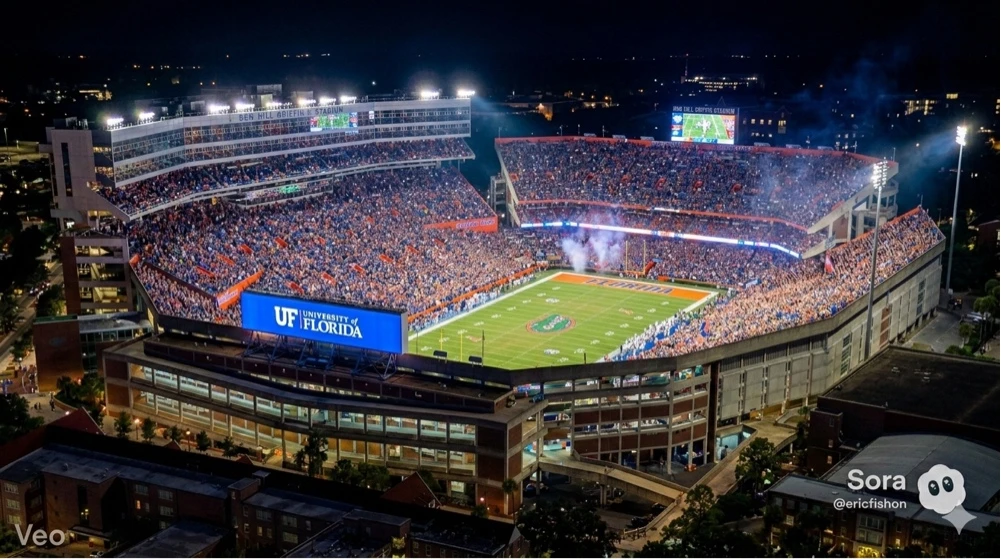
There is a reason why opposing quarterbacks tremble when they step onto Florida Field. It isn't just the heat; it is the Science of the Roar. Built into a natural sinkhole and then built upward with punishingly steep grades, Ben Hill Griffin Stadium acts as a literal megaphone directed at the field—and unfortunately, at every fan in the stands.
According to acoustic mapping, the stadium’s 'bowl' shape creates a parabolic reflector. When fans scream, the sound is focused toward the center and then reflected back into the lower and mid-level seating. In 2024, sound tests during peak moments reached levels equivalent to standing next to a chainsaw or a jet taking off. This is the 'Swamp's Roar'—a masterpiece of home-field advantage and a nightmare for stadium accessibility.
"The Swamp is not just a place where people yell; it is a structural amplifier designed to maximize human output." — Acoustic Engineering Insight
What most people get wrong is thinking that the noise is only a problem during the game. The science shows that the 'reverberation time'—how long a sound lingers—is significantly higher in concrete-heavy stadiums. This means that even during timeouts, the ambient hum remains at a level that prevents the nervous system from returning to a baseline state. For fans with invisible disabilities, the 'Roar' never truly stops until they leave the gates.
Invisible Disabilities: Why Sensory Rooms Are Vital
In the world of inclusive game day experiences, a sensory room is not a 'luxury suite'—it is a medical necessity. At Inclusive Game Day, we’ve developed the Sensory Equity Framework (SEF), which posits that for every 60 minutes of high-intensity sensory exposure, the neurodivergent brain requires 15 minutes of 'sensory neutrality' to maintain cognitive health.
Are there sensory rooms at Ben Hill Griffin Stadium? Currently, the University of Florida provides sensory kits (available at Guest Services) and has designated quiet areas, but the push for dedicated, permanent, sound-mitigated sensory rooms is the primary goal for 2025. These rooms are vital because they provide:
- Controlled Decompression: A space where lighting is dimmed and sound is dampened to below 50 decibels.
- Proprioceptive Input: Tools like weighted lap pads or sensory seating that help 'ground' a fan whose internal sense of balance has been disrupted by the crowd.
- Neural Reset: The ability to re-regulate the nervous system without having to leave the stadium and miss the rest of the game.
Without these rooms, we are effectively telling 15-20% of the population (the estimated percentage of neurodivergent individuals) that they are not welcome in the most iconic spaces of our culture. Inclusion isn't just about a seat; it's about the ability to stay in it.
5 Secrets to a Sensory-Friendly Game Day Experience
Navigating Gators football doesn't have to be a choice between total isolation and total overwhelm. If you are planning your next trip to The Swamp, use these five 'insider' secrets to protect your peace while still feeling the energy of the crowd.
- The 'North Endzone' Strategy: While the student section (East stands) is the epicenter of noise, the lower rows of the North Endzone often offer a slightly different acoustic profile where sound doesn't 'trap' as aggressively.
- Pre-Game Grounding: Arrive 90 minutes early. Let your brain map the stadium while it's empty. This 'environmental familiarization' reduces the anxiety of the unknown once the crowds arrive.
- The KultureCity Connection: Download the KultureCity app before you go. It provides a 'Sensory View' of venues, helping you identify where the 'loud zones' are and where you can find immediate relief.
- Timing Your Exits: Never leave your seat during a quarter break or halftime if you are prone to sensory overload. The concourses become 'choke points' of high-density touch and noise. Move when the ball is in play if you need to use the restroom or get water.
- The 'Sensory Anchor' Item: Carry a small, high-texture 'fidget' or grounding object in your pocket. In moments of peak noise, focusing on tactile input can 'distract' the brain from auditory flooding.
Why Noise-Canceling Headphones Are Essential
While foam earplugs are better than nothing, they often muffle sound in a way that feels 'under-stimulating' or 'muddy,' which can be just as frustrating. High-quality noise-canceling headphones (like Bose or Sony) or specialized high-fidelity earplugs (like Loop) are essential because they filter out the 'painful' frequencies while still allowing you to hear the announcer or your friends. They transform a wall of noise into a manageable soundtrack.
How to Navigate The Swamp With Invisible Disabilities
Navigating how to handle loud stadiums with invisible disabilities requires a tactical approach. Your game day starts at the gate. Avoid Gate 1 (the main student and high-traffic entrance). Instead, look for the ADA-accessible gates where the security process is often calmer and more methodical.
Once inside, make your first stop Guest Services. Even if you don't think you'll need a sensory kit immediately, checking in allows you to identify the specific staff members who are trained in sensory inclusion. Ask them: 'Where is the nearest quiet zone for this specific quarter?' Their real-time knowledge of crowd flow is invaluable.
Pro-Tip: Use the 'Buddy System' with a specific 'Sensory Signal.' Have a non-verbal hand signal (like touching your ear) that tells your companion, 'I am reaching my limit, and we need to move to a quieter area now.' This removes the need to struggle for words when your brain is already in 'survival mode.' Remember, there is no shame in taking a 10-minute break in the concourse to recalibrate. The Swamp will still be there when you get back.
The Truth About Stadium Access and Sensory Inclusion
Here is the contrarian truth that most sports brands won't tell you: ADA compliance is the floor, not the ceiling. Being 'ADA compliant' in 2025 simply means you've met the bare minimum legal requirements for physical access. It does not mean a stadium is truly inclusive for those with invisible disabilities.
The 'Truth' is that many stadiums use their 'historic' status as a shield against making the necessary structural changes for sensory health. But inclusion is a moving target. What was acceptable in 1995 is exclusionary in 2025. We are seeing a shift where fans are no longer satisfied with 'just being there.' They want to belong. Sensory inclusion is about moving from tolerance (allowing neurodivergent fans to attend) to hospitality (designing the experience for them).
What most people get wrong is thinking that sensory rooms and quiet zones 'spoil' the fan. In reality, these accommodations increase the 'Lifetime Value' of a fan. When a family with an autistic child knows they can safely attend a game at The Swamp, they become lifelong ticket holders. Inclusion is not just the right thing to do; it is the smartest business move a sports franchise can make.
Inclusive Game Day: The Future of Stadium Access
What does the future of stadium accessibility look like? By 2030, we predict that 'The Swamp' and other iconic venues will move beyond physical rooms and into 'Integrated Sensory Environments.' Imagine a stadium where your seat has a built-in haptic feedback system that translates the 'roar' into gentle vibrations for the deaf, or where augmented reality (AR) glasses can filter out the visual 'noise' of the crowd in real-time.
We are entering an era of Inclusive Game Day where technology will bridge the gap between the 'Science of the Roar' and the needs of the individual. We foresee the rise of 'Sensory-Neutral Zones'—entire sections of seating where the decibel level is electronically capped, allowing fans to enjoy the game in a controlled acoustic environment without being isolated in a room.
The roar of The Swamp is a beautiful thing, but it is only truly powerful when everyone can hear it—or feel it—in a way that doesn't cause harm. We are fighting for a world where every 'Gator Chomp' is a celebration of a community that leaves no fan behind. Your sensory health is your right. Let's make every game day an inclusive one.
Want to be part of the revolution? We’ve curated the world’s most comprehensive 'Sensory Stadium Guide' to help you navigate every major venue in the SEC. Download our 2025 Inclusive Game Day Toolkit for free today and reclaim your right to the roar.